Garbage Truck for Sale | How to Choose the Right Chassis
When purchasing a garbage truck for sale, buyers often focus on the waste body, compaction system, and loading mechanism. However, the chassis is equally important because it determines the vehicle’s payload capacity, engine performance, road adaptability, maintenance requirements, and overall operating cost.
A garbage truck is essentially a combination of two major systems:
- The truck chassis
- The waste collection body
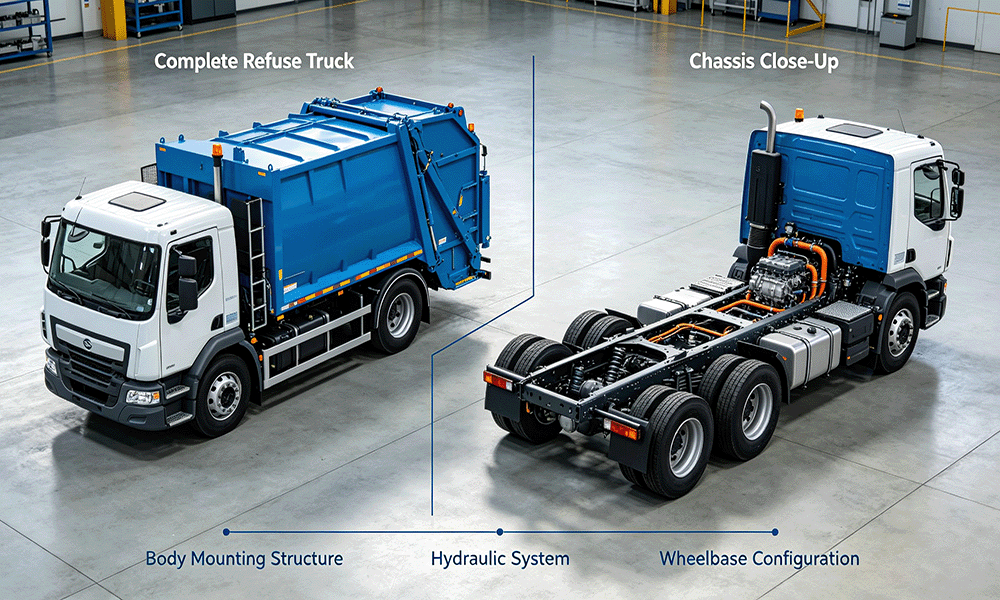
The chassis provides the power and driving platform, while the garbage body performs collection, lifting, and compaction operations.
Choosing the right chassis is therefore an important part of purchasing a garbage truck for municipal, commercial, and industrial waste collection.
TOPS VEHICLES provides different chassis options and can recommend suitable configurations according to the customer’s capacity requirements, road conditions, operating environment, and budget.
Why Is the Chassis Important for a Garbage Truck?
The chassis affects almost every aspect of garbage truck operation.
Important factors include:
- Payload capacity
- Engine power
- Fuel consumption
- Axle configuration
- Wheelbase
- Ground clearance
- Turning radius
- Braking performance
- Maintenance
- Spare parts availability
For example, a large 20 CBM compactor body requires a chassis capable of safely supporting the completed vehicle weight.
A small municipal garbage truck, on the other hand, may benefit more from maneuverability and fuel efficiency.
Therefore, the chassis should always be selected together with the garbage body.
Common Garbage Truck Chassis Options
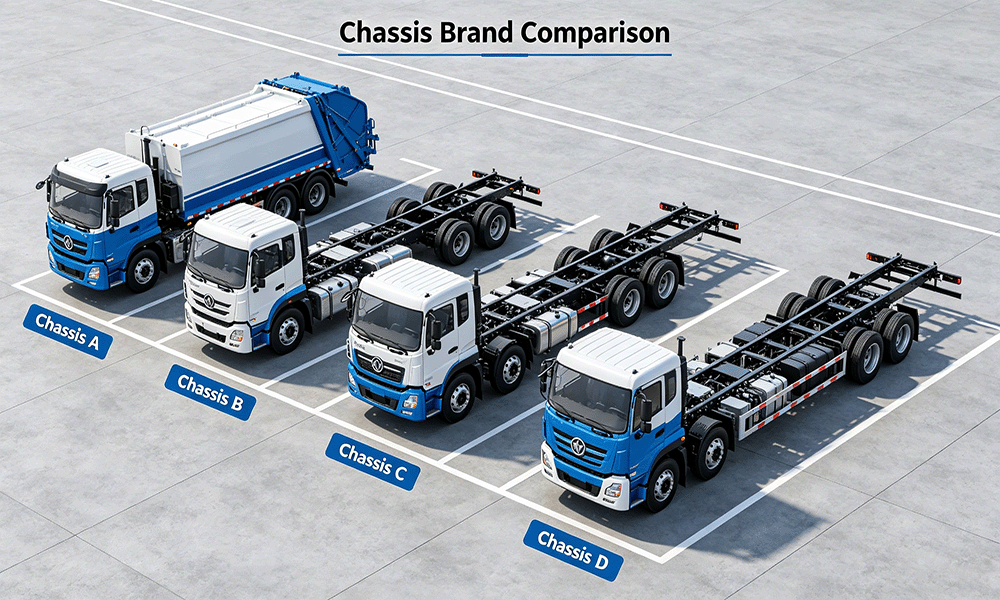
TOPS VEHICLES can provide garbage trucks using different commercial vehicle chassis brands.
Common options include:
ISUZU Chassis
ISUZU chassis are commonly selected for garbage collection projects where customers prioritize:
- Reliability
- Maneuverability
- Fuel efficiency
- Service availability
They can be suitable for small and medium-capacity garbage trucks.
HOWO Chassis
HOWO chassis are commonly considered for heavy-duty waste collection applications.
They can be configured for:
- Large garbage trucks
- High-capacity compactor trucks
- Heavy-duty municipal projects
- Long-distance transportation
FOTON Chassis
FOTON provides another option for customers looking for commercial truck chassis for waste collection applications.
It can be considered for:
- Medium-duty garbage trucks
- Municipal sanitation
- Commercial waste collection
Dongfeng Chassis
Dongfeng chassis are widely used across different commercial vehicle applications and can be configured for various garbage truck bodies.
They can be suitable for:
- Municipal collection
- Residential waste
- Commercial waste
- Medium-capacity vehicles
SHACMAN Chassis
SHACMAN chassis are particularly suitable for customers requiring heavy-duty vehicle configurations.
They can be considered for:
- Large-capacity garbage trucks
- Heavy waste transportation
- Industrial applications
- Long-distance routes
Garbage Truck Chassis and Payload
One of the most important factors when selecting a chassis is payload.
The completed vehicle weight includes:
- Chassis weight
- Garbage body
- Hydraulic system
- Lifting mechanism
- Compaction equipment
- Waste load
The chassis must have sufficient Gross Vehicle Weight capacity for the intended application.
Buyers should therefore compare:
GVW + body weight + expected payload
rather than looking only at the advertised garbage body capacity.
Garbage Truck Chassis and Body Capacity
Different body capacities require different chassis configurations.
A general guide is:
| Garbage Body Capacity | Typical Chassis Class |
|---|---|
| 3–5 CBM | Light-duty chassis |
| 5–8 CBM | Light/medium-duty chassis |
| 8–12 CBM | Medium-duty chassis |
| 12–16 CBM | Medium/heavy-duty chassis |
| 16–20 CBM | Heavy-duty chassis |
| 20–25 CBM | Heavy-duty chassis |
These are general guidelines rather than fixed specifications.
The final chassis should be selected according to the actual body dimensions, vehicle weight, waste density, axle load limits, and local regulations.
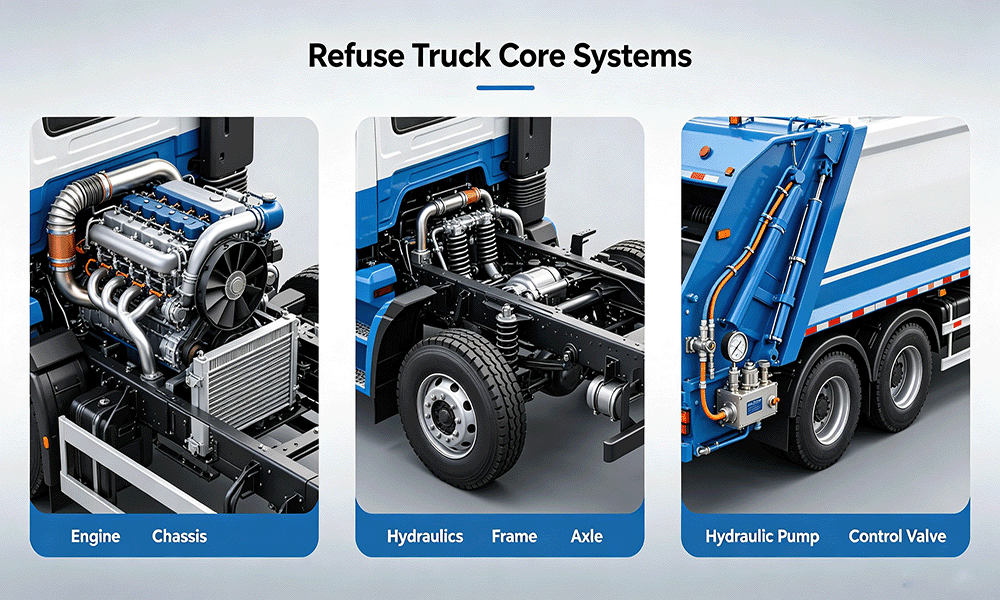
Garbage Truck Engine Selection
The engine is another important component of a garbage truck chassis.
Buyers should consider:
- Engine power
- Fuel type
- Fuel consumption
- Emission requirements
- Local fuel availability
- Maintenance capability
- Spare parts availability
A larger engine does not necessarily mean a better garbage truck.
The engine should provide sufficient power for:
- Vehicle weight
- Waste payload
- Road gradients
- Collection routes
- Compaction operations
For mountainous or heavily loaded routes, customers may require a stronger powertrain than vehicles operating primarily on flat urban roads.
Garbage Truck Chassis and Road Conditions
Road conditions should be considered before choosing the chassis.
Urban Roads
For city collection, buyers may prioritize:
- Maneuverability
- Smaller turning radius
- Moderate wheelbase
- Fuel efficiency
Rural Roads
For rural collection routes, buyers may require:
- Higher ground clearance
- Durable suspension
- Better road adaptability
- Reliable powertrain
Mountainous Areas
Mountainous routes may require:
- Higher engine power
- Appropriate axle configuration
- Strong braking performance
- Suitable transmission ratios
Long-Distance Routes
For long-distance transportation, customers may prioritize:
- Fuel efficiency
- Engine durability
- Driver comfort
- Larger payload
- Reliable braking systems
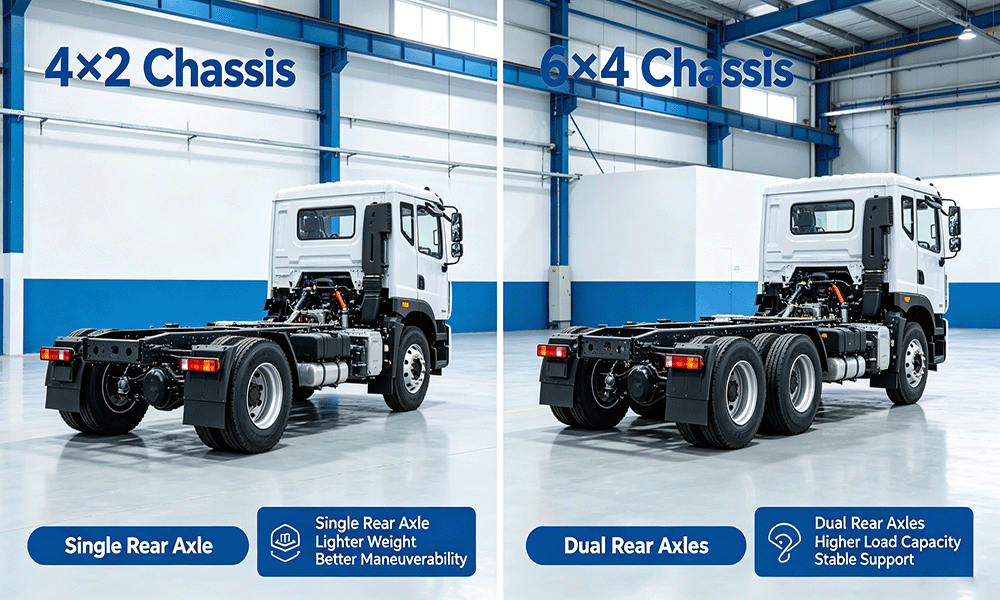
4×2, 6×4 or Other Axle Configurations?
Axle configuration should match the operating environment and vehicle weight.
4×2 Garbage Truck
Suitable for:
- Urban waste collection
- Smaller garbage bodies
- Flat roads
- Residential routes
Advantages include:
- Lower operating cost
- Good maneuverability
- Easier maintenance
6×4 Garbage Truck
A 6×4 configuration can be considered for:
- Heavy-duty applications
- Large-capacity bodies
- Industrial waste collection
- Difficult road conditions
The additional driven axle can provide greater traction and support heavier vehicle configurations.
Other Configurations
Depending on the project, other chassis configurations may also be available.
TOPS VEHICLES can recommend the appropriate configuration based on vehicle capacity, operating conditions, and local regulations.
Garbage Truck Chassis and Maintenance
Maintenance should be considered before purchasing a garbage truck.
A technically advanced chassis may not be the best choice if spare parts and service support are difficult to obtain in the destination market.
Before purchasing, buyers should check:
- Local service network
- Spare parts availability
- Engine maintenance
- Transmission service
- Brake system
- Electrical components
- Hydraulic system support
TOPS VEHICLES can provide spare parts and technical documentation to support customers after delivery.
How Much Does a Garbage Truck Chassis Affect Price?
The chassis can represent a significant part of the total garbage truck cost.
The final price may depend on:
- Chassis brand
- Engine
- GVW
- Axle configuration
- Wheelbase
- Transmission
- Emission standard
- Tire configuration
- Body capacity
- Loading system
Therefore, two garbage trucks with the same 12 CBM body may have noticeably different prices if they use different chassis configurations.
For a more detailed discussion of purchase costs, see our Garbage Truck Price guide.
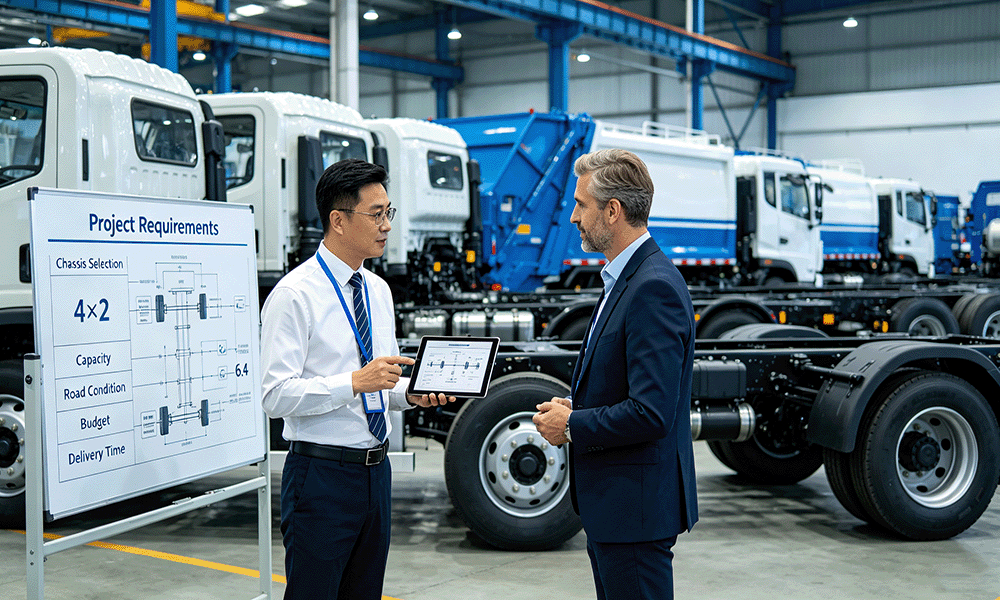
How to Choose the Right Garbage Truck Chassis
Before purchasing, buyers should answer the following questions.
What is the required garbage body capacity?
The chassis must support the complete vehicle weight and intended waste payload.
What type of roads will the truck use?
Urban, rural, mountainous, and long-distance routes can require different chassis configurations.
What is the local payload regulation?
Local axle and GVW restrictions must be considered before finalizing the chassis.
Is the chassis brand supported locally?
Good spare parts availability can reduce downtime and maintenance costs.
What is the required engine power?
Engine power should match the completed vehicle weight and operating conditions.
What is the project budget?
The cheapest chassis is not always the lowest-cost solution over the entire vehicle lifecycle.
Garbage Truck Chassis Customization
TOPS VEHICLES can customize garbage trucks according to project requirements.
Available options may include:
- Chassis brand
- Engine specification
- Wheelbase
- Axle configuration
- Tire configuration
- Garbage body capacity
- Hydraulic system
- Loading mechanism
- Container lifter
- Paint color
- Customer logo
This allows international customers to receive a garbage truck configuration adapted to their local operating environment.
Why Buy a Garbage Truck from TOPS VEHICLES?
TOPS VEHICLES combines chassis selection with complete garbage truck body engineering.
Instead of selecting a chassis separately and then attempting to match a waste body afterward, customers can receive an integrated vehicle solution.
Our team can assist with:
- Vehicle selection
- Chassis recommendations
- Capacity selection
- Loading system selection
- Technical specifications
- OEM customization
- Export documentation
- Spare parts
- Shipping coordination
Request a Garbage Truck for Sale Quotation
If you are looking for a garbage truck for sale, send us your basic requirements:
- Required capacity
- Waste type
- Daily waste volume
- Road conditions
- Destination country
- Number of trucks
- Preferred chassis brand
- Required loading system
TOPS VEHICLES can recommend suitable chassis and garbage truck configurations based on your project.
You can then compare the complete technical specifications and quotation before making a purchasing decision.
FAQ
Which chassis is best for a garbage truck?
There is no single best chassis for every garbage truck. The appropriate choice depends on capacity, payload, road conditions, engine requirements, local regulations, and spare parts availability.
What chassis brands can be used for garbage trucks?
Common options include ISUZU, HOWO, FOTON, Dongfeng, and SHACMAN. Availability depends on the specific vehicle model and project requirements.
Does chassis brand affect garbage truck price?
Yes. Chassis brand, engine, GVW, axle configuration, and specifications can all affect the final garbage truck price.
What chassis is suitable for a 10 CBM garbage truck?
A medium-duty 4×2 chassis can often be considered for a 10 CBM garbage truck, but the final selection should be based on the completed vehicle weight, payload, and local road regulations.
What chassis is suitable for a 20 CBM garbage truck?
A heavy-duty chassis may be required for a 20 CBM garbage truck. The final configuration depends on body weight, waste density, payload, and local GVW restrictions.
Is 4×2 suitable for garbage collection?
Yes. 4×2 garbage trucks are commonly used for urban and residential waste collection, especially where roads are relatively good and vehicle capacity is moderate.
Is 6×4 better than 4×2?
Not necessarily. A 6×4 can provide advantages for heavier applications and difficult road conditions, while a 4×2 can offer better maneuverability and lower operating costs for many urban routes.
Can I specify my preferred chassis brand?
Yes. Customers can request a preferred chassis brand, subject to vehicle compatibility and availability in the target market.