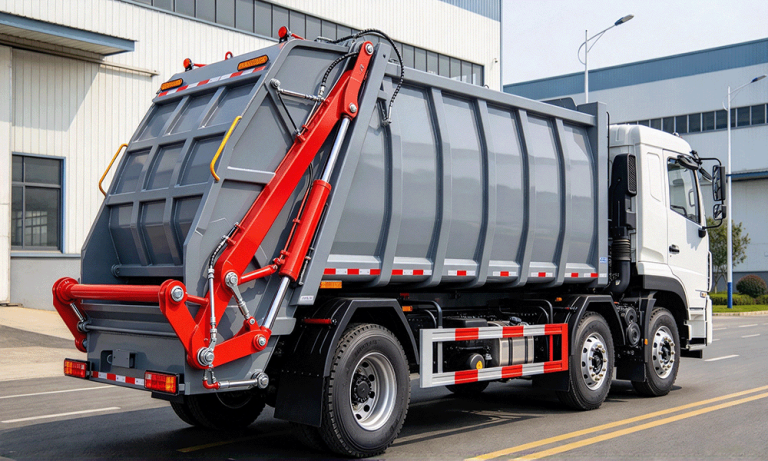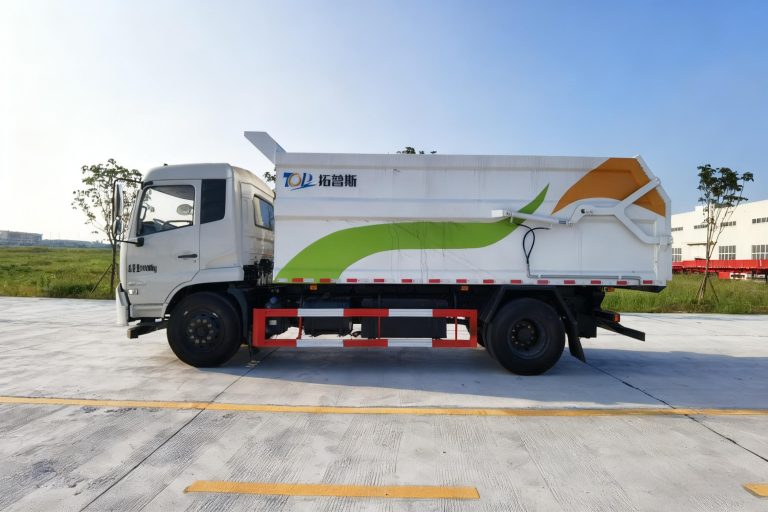
Garbage Truck with Hook Lift for Sale | Container & Price Guide
Garbage Truck with Hook Lift for Sale: Container Types, Capacity and Price
A garbage truck with hook lift for sale is designed for waste collection projects that use detachable containers rather than only conventional household garbage bins.
Instead of permanently loading waste directly into a fixed garbage body, a hook lift system allows the truck to connect to, lift and transport a compatible waste container.
This configuration can be useful for industrial waste, commercial waste, construction-related waste, transfer stations and other applications where different containers need to be moved between collection points and disposal or processing facilities.
For buyers, the most important factors are not simply the truck’s engine or garbage body capacity. The container dimensions, container weight, hook height, lifting capacity, chassis payload and hydraulic system all need to work together.
This guide explains how hook lift garbage trucks work, what types of containers they can handle, how much they can lift, what affects the price and what information buyers should provide when requesting a quotation.
What Is a Garbage Truck with Hook Lift?
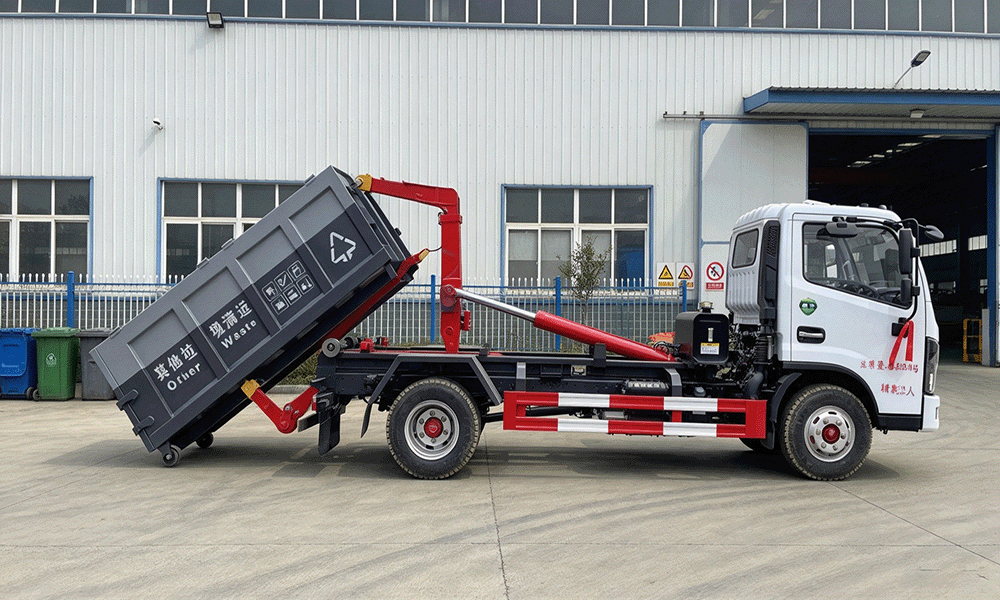
A garbage truck with hook lift is a waste collection or container-handling vehicle equipped with a hydraulic hook mechanism.
The hook connects to a specially designed lifting point on a detachable container.
The hydraulic system then moves the hook and container onto the truck chassis.
A typical hook lift system may include:
- Hydraulic hook
- Hydraulic cylinder
- Hydraulic pump
- Hydraulic control valve
- Hydraulic hoses
- Hook lifting mechanism
- Container locking system
- Subframe
- Truck chassis
- Control system
Unlike a conventional compactor garbage truck, the container itself may be detachable.
This allows the same truck to perform different container-handling tasks when multiple compatible containers are available.
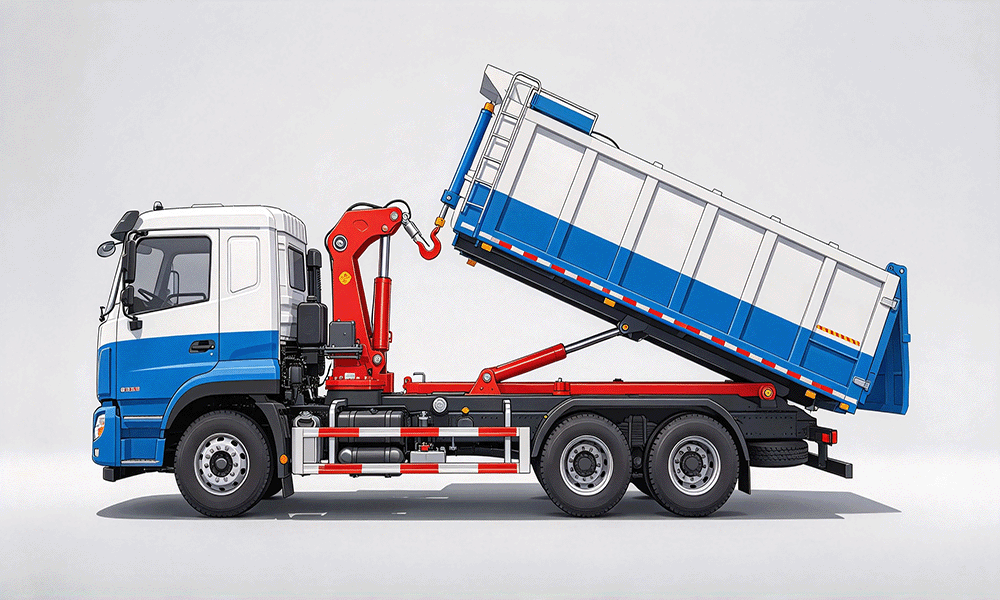
How Does a Hook Lift Garbage Truck Work?
The basic operating process is based on a hydraulic lifting mechanism.
Step 1: Position the Truck
The truck reverses or moves into the correct position in front of the empty or loaded container.
Step 2: Engage the Hook
The hydraulic hook is positioned near the container’s lifting bar or connection point.
Step 3: Connect the Container
The hook engages with the container.
The connection dimensions must match the hook lift system.
Step 4: Activate the Hydraulic System
The hydraulic cylinder moves the lifting mechanism.
The container is gradually pulled or rolled onto the truck.
Step 5: Lock the Container
Once the container reaches the correct position, the locking mechanism secures it for transportation.
Step 6: Transport the Container
The truck transports the container to the disposal, transfer, recycling or processing location.
Step 7: Unload the Container
At the destination, the hydraulic system can move the container off the truck.
The exact loading and unloading process depends on the hook lift design and container configuration.
Hook Lift vs. Standard Garbage Truck
A hook lift truck operates differently from a conventional fixed-body garbage truck.
A standard garbage truck normally has a permanently mounted garbage collection body.
A hook lift truck is designed around detachable containers.
| Feature | Fixed Garbage Truck | Hook Lift Garbage Truck |
|---|---|---|
| Container | Usually integrated body | Detachable container |
| Main operation | Collect and compact waste | Lift and transport containers |
| Container exchange | Limited | Designed for container exchange |
| Flexibility | Moderate | High |
| Industrial waste | Configuration dependent | Common application |
| Commercial waste | Suitable | Suitable |
| Container transport | Limited | Main function |
| Multiple containers | Less flexible | Can use compatible containers |
This difference is important when selecting a vehicle.
If your project requires workers to collect individual household bins from residential streets, a rear loader or side loader may be more appropriate.
If the project involves transporting large detachable waste containers, a hook lift system may be more suitable for the required operation.
What Types of Containers Can a Hook Lift Garbage Truck Handle?
Container compatibility is one of the most important factors when purchasing a hook lift truck.
The container should be designed with a compatible lifting point and dimensions.
Depending on the system, applications may include:
Detachable Waste Containers
These containers are designed to be loaded onto and unloaded from the truck.
They can be used for commercial or industrial waste collection.
Industrial Waste Containers
Factories may generate large volumes of production waste that need to be collected in larger containers.
A hook lift truck can transport the filled container to another location.
Construction Waste Containers
Construction and demolition projects may require temporary waste containers at different locations.
A hook lift truck can move these containers as required.
Recycling Containers
Some recycling operations use detachable containers for materials such as:
- Cardboard
- Paper
- Metal
- Plastic
- Mixed recyclable materials
The truck configuration should be matched to the specific container system used by the recycling operator.
Specialized Waste Containers
Certain projects may use containers for specific waste streams.
In these cases, the container dimensions, loading weight and connection design should be provided before the truck is manufactured.
What Types of Containers Can a Hook Lift Garbage Truck Handle?
Container compatibility is one of the most important factors when purchasing a hook lift truck.
The container should be designed with a compatible lifting point and dimensions.
Depending on the system, applications may include:
Detachable Waste Containers
These containers are designed to be loaded onto and unloaded from the truck.
They can be used for commercial or industrial waste collection.
Industrial Waste Containers
Factories may generate large volumes of production waste that need to be collected in larger containers.
A hook lift truck can transport the filled container to another location.
Construction Waste Containers
Construction and demolition projects may require temporary waste containers at different locations.
A hook lift truck can move these containers as required.
Recycling Containers
Some recycling operations use detachable containers for materials such as:
- Cardboard
- Paper
- Metal
- Plastic
- Mixed recyclable materials
The truck configuration should be matched to the specific container system used by the recycling operator.
Specialized Waste Containers
Certain projects may use containers for specific waste streams.
In these cases, the container dimensions, loading weight and connection design should be provided before the truck is manufactured.
Hook Height and Container Compatibility
A hook lift truck cannot be selected correctly based only on lifting capacity.
Hook height is also critical.
Different container systems may have different hook heights and connection dimensions.
The buyer should confirm:
- Hook height
- Hook diameter or connection dimensions
- Container length
- Container width
- Container height
- Container lifting bar position
- Container total weight
- Required ground clearance
If the hook height does not match the container, the truck may require a different hook configuration or the container may need modification.
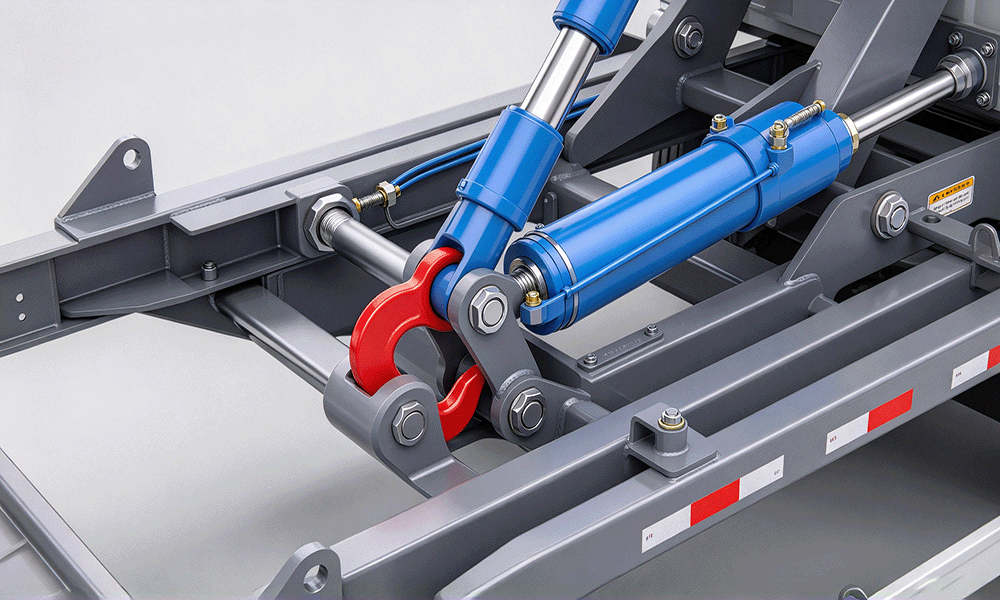
Hydraulic Hook Lift System Components
A hook lift garbage truck normally relies on several hydraulic and mechanical components.
Hydraulic Pump
The pump provides hydraulic flow for the lifting mechanism.
Hydraulic Cylinder
The cylinder converts hydraulic pressure into mechanical movement.
Hook
The hook engages with the lifting point on the container.
Hydraulic Control Valve
The control valve manages hydraulic flow and movement.
Hydraulic Hoses
Hoses transport hydraulic fluid between the pump, control valve and cylinders.
Container Locking System
Once the container is loaded, the locking mechanism helps keep it securely positioned during transportation.
The exact components and configuration depend on the required lifting capacity and container system.
Hook Lift Garbage Truck Applications
A hook lift garbage truck can be used in several commercial and industrial waste management applications.
Industrial Waste Collection
Factories may generate large quantities of production waste.
A detachable container can remain at the factory while the truck transports a full container away and brings another empty container.
This can reduce unnecessary waiting time during waste collection.
Construction Waste
Construction sites can use temporary containers for waste materials.
When a container is full, the hook lift truck can transport it to the appropriate disposal or processing facility.
Commercial Waste Collection
Shopping centers, warehouses, large restaurants and other commercial properties may require larger waste containers than those used for household collection.
Recycling Operations
Detachable containers can be used to collect recyclable materials.
Multiple containers can be assigned to different material streams depending on the operating system.
Waste Transfer Operations
A hook lift truck can also be used for moving waste containers between collection points and transfer or processing facilities.
Hook Lift vs. Hydraulic Arm Garbage Truck
The two systems may appear similar because both use hydraulic mechanisms to handle containers, but their operating principles are different.
A hydraulic arm generally uses a movable arm to lift or manipulate a container.
A hook lift system is specifically designed to engage a container’s hook point and pull or roll the container onto the truck.
| Feature | Hydraulic Arm | Hook Lift |
|---|---|---|
| Main function | Lift/manipulate containers | Load/unload detachable containers |
| Connection | Arm attachment | Hook point |
| Container system | More flexible depending on design | Requires compatible hook container |
| Container exchange | Possible | Core function |
| Industrial use | Possible | Common |
| Construction waste | Possible | Common |
| Hydraulic operation | Yes | Yes |
| Container compatibility | Depends on attachment | Critical |
The right choice depends on the customer’s existing container system.
For projects using standardized wheeled bins, a bin-lifting garbage truck may be more appropriate.
For projects using detachable containers, a hook lift system can provide a different operating model.
Can a Hook Lift Truck Also Compact Garbage?
The answer depends on the specific configuration.
A hook lift truck primarily handles and transports containers.
Some waste management systems use separate detachable compactor containers or specialized containers that provide compaction.
In other projects, the hook lift truck is simply responsible for moving the container, while compaction takes place separately.
Therefore, buyers should clearly define whether they need:
- Container transportation only
- Waste collection
- Waste compaction
- Detachable compactor containers
- Combination waste-handling equipment
This distinction can significantly affect the vehicle configuration and quotation.
For conventional compacting collection trucks, see our guide to compactor garbage trucks for sale.
Hook Lift Garbage Truck Capacity
The overall truck specification should be matched to the container size and maximum loaded weight.
A larger container does not automatically mean that a larger hook lift is required.
The manufacturer should evaluate:
Container volume + waste density + maximum loaded weight + container dimensions + lifting geometry + chassis payload
For example, a container used for lightweight packaging waste may have a large volume while remaining relatively light.
A smaller container filled with heavy industrial material may impose a much greater load on the truck.
This is why buyers should provide the maximum loaded container weight when requesting a quotation.
You can also compare different garbage truck body capacities in our garbage truck for sale by capacity guide.
What Affects the Price of a Hook Lift Garbage Truck?
The price of a hook lift garbage truck varies according to the complete configuration.
Major cost factors include:
Chassis
The chassis determines the basic payload, engine, axle configuration and road capability.
Hook Lift Capacity
A higher-capacity hydraulic system generally requires stronger components and a suitable chassis.
Hook Lift Design
The hook structure, hydraulic cylinders and supporting frame influence cost.
Container Type
If the truck requires compatibility with a special container system, additional engineering may be required.
Hydraulic System
Pump capacity, cylinders, control valves and other hydraulic components affect the final price.
Container Quantity
For projects requiring multiple containers, buyers should specify whether containers are included in the quotation.
Export Configuration
International buyers may also need to consider:
- Driving position
- Chassis brand
- Spare parts
- Shipping method
- Destination port
- Documentation
- Painting
- Optional equipment
Therefore, a realistic quotation should be based on a complete technical specification rather than only the phrase “hook lift garbage truck.”
For a broader explanation of garbage truck pricing, see garbage truck price.
How to Choose the Right Hook Lift Garbage Truck
Before purchasing, buyers should collect the following information.
Container Information
- Container length
- Container width
- Container height
- Container volume
- Empty container weight
- Maximum loaded weight
- Hook height
- Hook connection dimensions
Truck Information
- Required payload
- Required hook lift capacity
- Chassis brand
- Engine specification
- Axle configuration
- Driving position
Operating Information
- Waste type
- Daily collection volume
- Average collection distance
- Road conditions
- Loading frequency
- Disposal or transfer location
Project Information
- Destination country
- Destination port
- Quantity required
- Required delivery schedule
- Spare parts requirements
- Special customization
Providing this information allows the supplier to calculate a more appropriate configuration.
Hook Lift Garbage Truck for Municipal Projects
Municipal waste collection can involve multiple types of waste containers and collection locations.
A hook lift system can be useful where the municipality operates a container-based waste management system.
For example:
Collection Point → Detachable Container → Hook Lift Truck → Transfer Station → Disposal/Processing Facility
The same operating concept can also be used for:
- Public facilities
- Markets
- Parks
- Municipal maintenance
- Recycling centers
- Temporary waste collection points
However, the truck should be selected according to the municipality’s existing container standards.
If the project instead relies on standardized household bins, a rear loader or side loader garbage truck may provide a more appropriate configuration.
Hook Lift Garbage Truck for Commercial and Industrial Waste
Commercial and industrial waste collection can have very different requirements from residential collection.
A factory may generate heavy production waste.
A warehouse may generate large amounts of packaging material.
A construction site may generate bulky waste.
A hotel or shopping center may generate a combination of food waste, packaging and general waste.
Because of these differences, the same hook lift configuration should not automatically be applied to every customer.
The most important question is:
What is the maximum loaded container weight and what container system is already being used?
Once this is known, the hydraulic system, chassis and hook lift can be configured more accurately.
What Should Be Included in a Hook Lift Garbage Truck Quotation?
A professional quotation should clearly identify the major components.
The buyer should ideally receive:
- Chassis brand and model
- Engine specification
- Gross vehicle weight
- Payload
- Hook lift capacity
- Container dimensions
- Hydraulic system specifications
- Control system
- Container locking method
- Garbage container quantity, if included
- Vehicle dimensions
- Warranty information
- Spare parts options
- Delivery time
- FOB or CIF price
- Destination port
This makes it easier to compare different suppliers.
Two trucks may both be described as “hook lift garbage trucks,” but their chassis, lifting capacity and container configuration may be significantly different.
Why Container Information Should Be Provided Before Ordering
One of the most important purchasing mistakes is ordering a hook lift truck without confirming the container specifications.
A buyer may know:
“We need a 10-ton hook lift truck.”
But this alone does not provide enough information.
The supplier may still need to know:
- What container will be lifted?
- What is its hook height?
- What is its total length?
- What is the maximum loaded weight?
- What is the container’s center of gravity?
- How frequently will it be loaded and unloaded?
If possible, send the manufacturer container drawings, photographs or technical specifications.
This allows the hook lift system to be designed around the actual operating equipment.
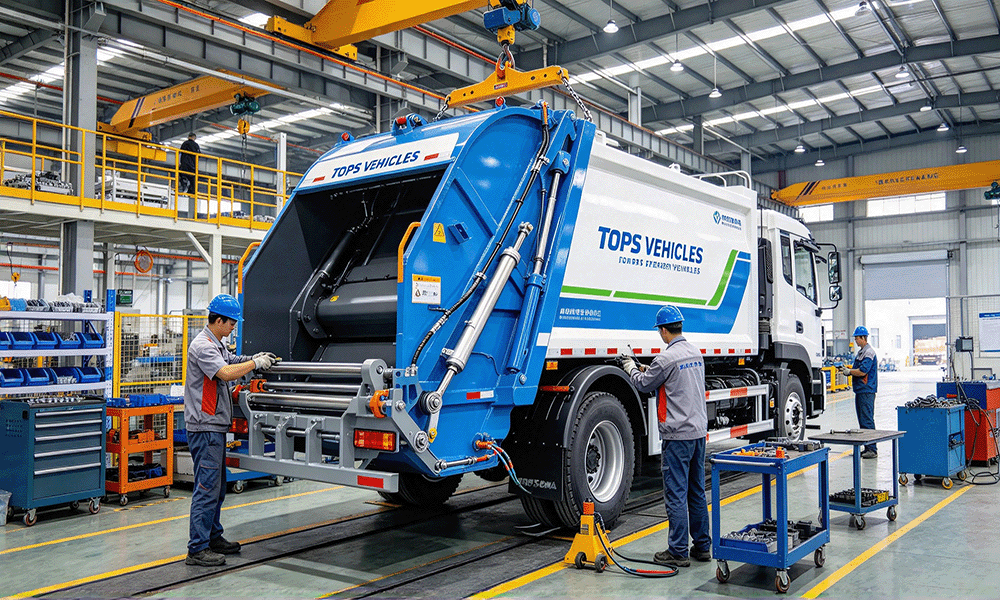
TOPS VEHICLES Hook Lift Garbage Truck Customization
For international waste collection projects, the complete vehicle configuration may need to be adapted to the buyer’s operating requirements.
At TOPS VEHICLES, buyers can provide information about:
- Container type
- Container dimensions
- Required lifting capacity
- Garbage volume
- Chassis preference
- Driving position
- Destination country
- Quantity
The vehicle configuration can then be evaluated according to the intended waste collection application.
For projects involving detachable containers, container compatibility should be confirmed before final production.
Hook Lift Garbage Truck Buying Checklist
Before placing an order, confirm:
- Container type confirmed
- Container dimensions confirmed
- Hook height confirmed
- Hook connection confirmed
- Empty container weight confirmed
- Maximum loaded container weight confirmed
- Required hook lift capacity confirmed
- Truck payload confirmed
- Chassis specification confirmed
- Hydraulic system confirmed
- Container locking system confirmed
- Container quantity confirmed
- Vehicle dimensions confirmed
- Destination port confirmed
- Spare parts confirmed
- Final quotation confirmed
- Delivery time confirmed
This checklist helps ensure that the vehicle and container system are compatible before production begins.
FAQ: Garbage Truck with Hook Lift for Sale
1. What is a hook lift garbage truck?
A hook lift garbage truck is a waste-handling vehicle equipped with a hydraulic hook mechanism designed to load, transport and unload compatible detachable waste containers.
2. What containers can a hook lift truck carry?
It can carry containers designed with compatible hook points and dimensions. Container length, hook height, weight and connection specifications should be confirmed before ordering.
3. How much can a hook lift garbage truck lift?
The lifting capacity depends on the hydraulic system, chassis, container dimensions, lifting geometry and maximum loaded container weight. The actual requirement should be calculated from the customer’s container specifications.
4. Can a hook lift truck carry industrial waste?
Yes. Hook lift systems can be configured for commercial and industrial waste containers, subject to the required payload and container compatibility.
5. Can the container be removed from the truck?
Yes. A detachable container is one of the main characteristics of a hook lift system. The truck can load and unload compatible containers.
6. Is a hook lift the same as a garbage bin lifter?
No. A bin lifter is generally designed for lifting standardized garbage bins, while a hook lift is designed around detachable containers with compatible hook points.
7. How much does a hook lift garbage truck cost?
Price depends on the chassis, hook lift capacity, hydraulic system, container configuration, payload, optional equipment and export requirements.
8. What information do I need to request a quotation?
Provide the container dimensions, hook height, empty and loaded container weight, required truck capacity, quantity, destination port and any chassis preferences.