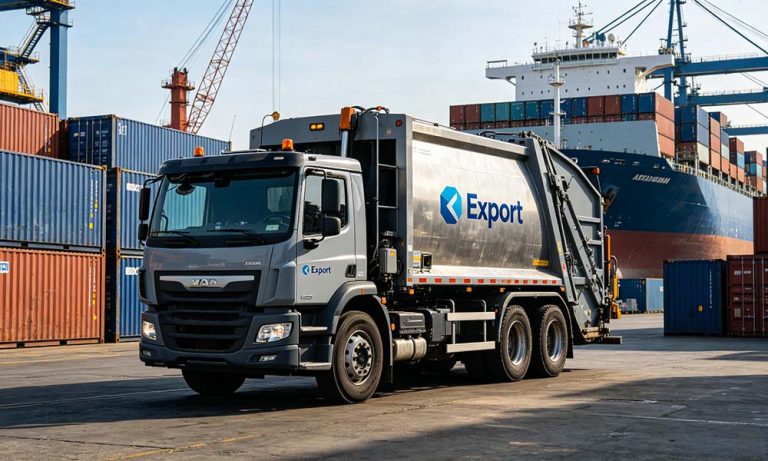
Garbage Truck with Skip Loader for Sale | Capacity & Price
Garbage Truck with Skip Loader for Sale: Container Types, Capacity and Price
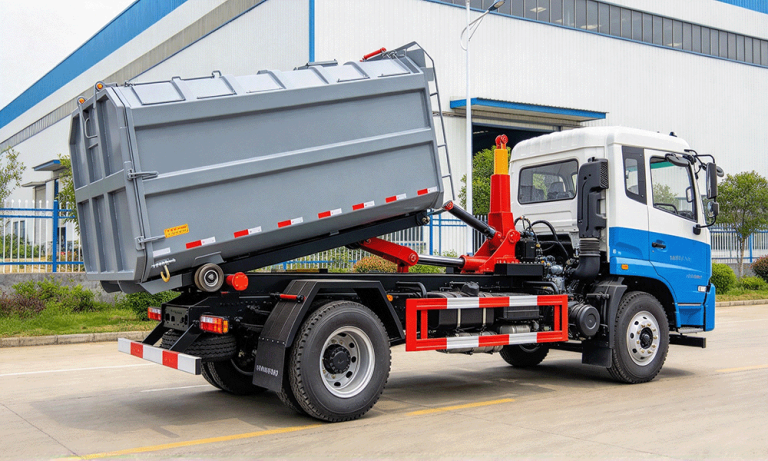
A garbage truck with skip loader for sale is designed to collect and transport waste containers using a hydraulic lifting and loading system.
Unlike conventional garbage trucks that collect waste directly into a fixed body, a skip loader can handle detachable containers that are placed at commercial, industrial, construction or other waste collection locations.
The system is particularly useful when waste containers need to be lifted from the ground and positioned onto the truck for transportation.
Les applications typiques sont les suivantes
- Collecte des déchets commerciaux
- Collecte des déchets industriels
- Déchets de chantier
- Bulky waste
- Recyclage
- Collecte des déchets en conteneurs par la municipalité
- Factory waste
- Grands établissements commerciaux
For buyers, choosing the right skip loader is not simply a matter of selecting a truck with a certain engine or container volume.
Le container dimensions, container weight, lifting capacity, hydraulic system, chassis payload and operating environment all need to match.
This guide explains how skip loader garbage trucks work, what types of containers they can handle, how to select the right capacity and what affects the purchase price.
2. What Is a Skip Loader Garbage Truck?
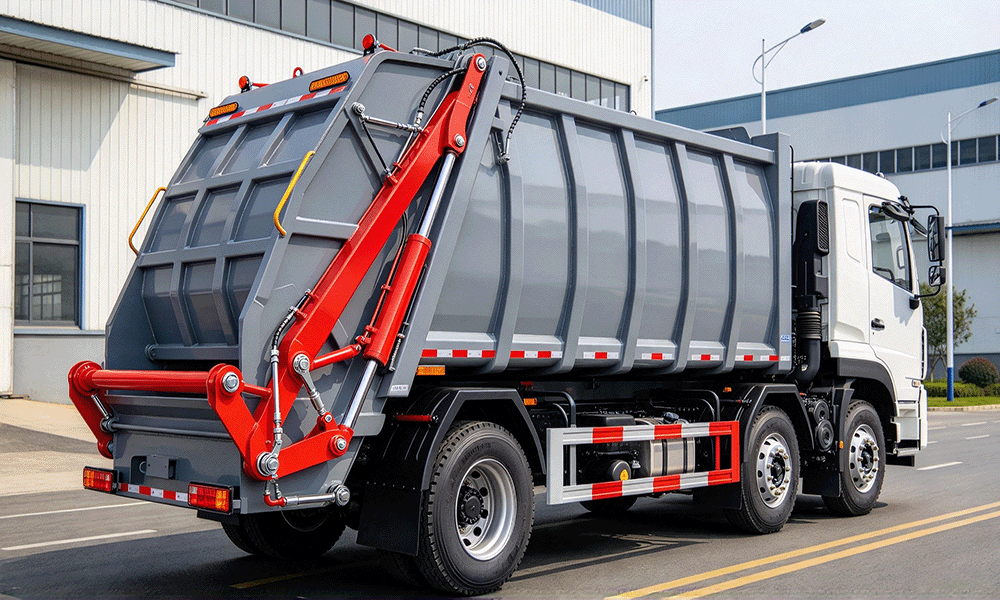
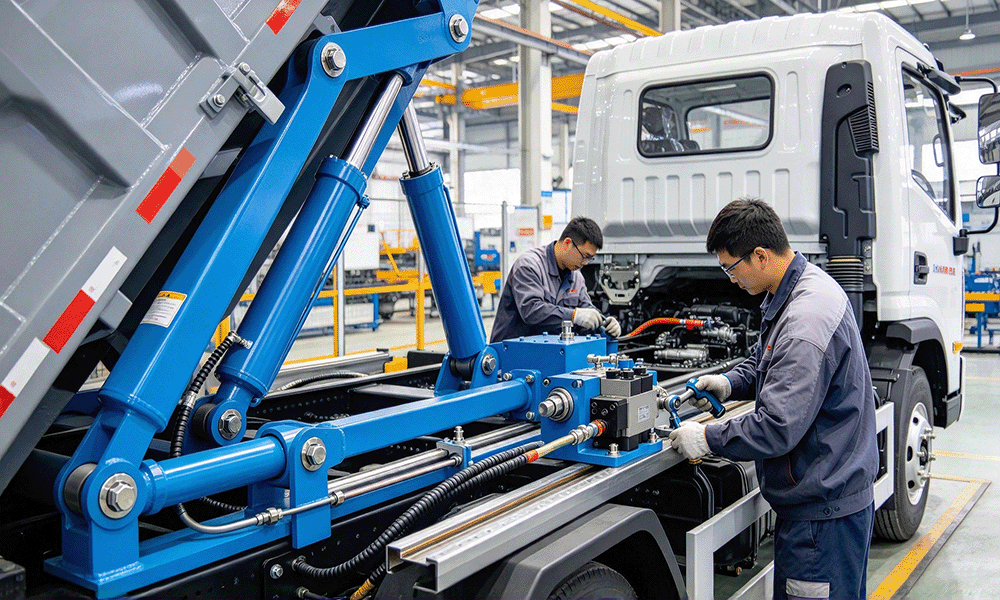
A skip loader garbage truck is a vehicle equipped with a hydraulic mechanism designed to lift a waste container from the ground and place it onto the truck.
The term skip loader generally refers to a container-loading system rather than a conventional fixed garbage body.
A typical system can include:
- Châssis de camion
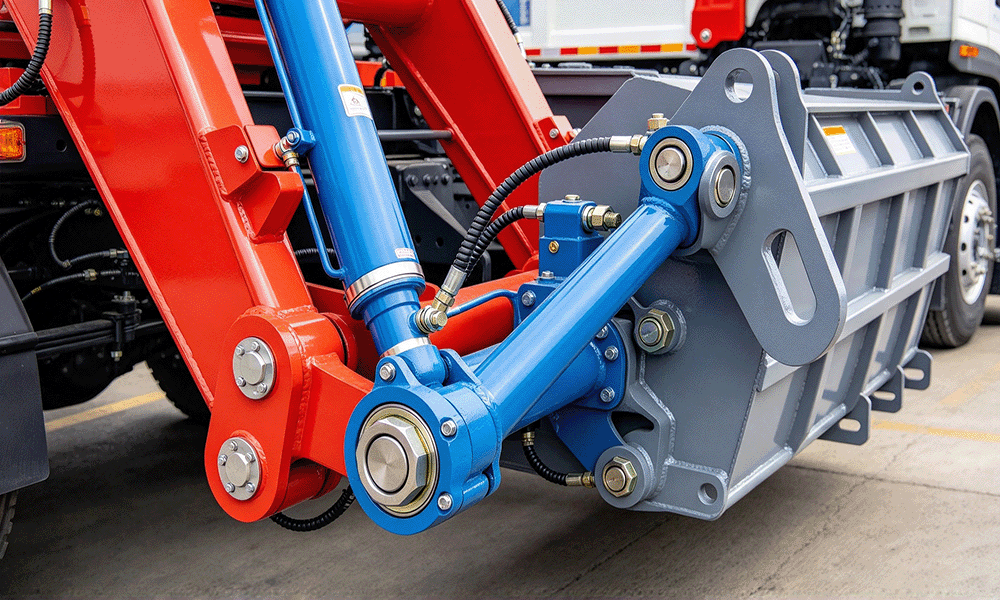
- Hydraulic lifting arms
- Cylindres hydrauliques
- Pompe hydraulique
- Hydraulic control valves
- Système de verrouillage de conteneur
- Container support structure
- Skip container
- Flexibles hydrauliques
The exact configuration can vary depending on the container dimensions and required lifting capacity.
Unlike a standard rear loader or side loader, the skip loader is primarily designed for detachable container handling.
3. How Does a Skip Loader Garbage Truck Work?
The operating process normally involves several stages.
Étape 1 : Positionner le camion
The truck approaches the waste container and aligns itself with the container loading position.
Step 2: Position the Hydraulic Arms
The hydraulic arms are positioned around or beside the container according to the specific loading design.
Step 3: Connect to the Container
The lifting mechanism engages with the container’s lifting points.
Step 4: Lift the Container
The hydraulic cylinders generate the force required to raise the container.
Step 5: Load the Container
The container is lifted and moved onto the truck’s supporting structure.
Step 6: Secure the Container
The container is locked or secured for transportation.
Step 7: Transport the Waste
The truck carries the loaded container to the disposal, transfer, recycling or processing facility.
Step 8: Unload the Container
At the destination, the hydraulic system lowers the container back to the ground.
This operating process allows containers to be collected without manually transferring waste from one container to another.
4. What Is a Skip Container?
A skip container is a detachable waste container designed to be handled by a skip loader or compatible lifting system.
Compared with small household garbage bins, skip containers are generally:
- Larger
- Stronger
- Designed for mechanical handling
- Equipped with lifting points
- Suitable for bulk waste
- Designed for repeated loading and unloading
Skip containers can be used for different types of waste depending on their construction and volume.
Par exemple :
- Déchets de chantier
- Déchets industriels
- Déchets professionnels
- Green waste
- Bulky waste
- Matériaux recyclables
The exact container design should match the skip loader system.
A buyer should therefore provide container drawings or photographs when ordering a customized vehicle.
5. Skip Loader vs. Roll-Off Garbage Truck
Skip loader and roll-off systems are both used to transport detachable waste containers, but their loading mechanisms can be different.
A skip loader typically uses hydraulic arms to lift the container onto the truck.
A roll-off system generally moves the container along a loading path using a hook or similar mechanism.
| Fonctionnalité | Skip Loader | Roll-Off System |
|---|---|---|
| Main mechanism | Hydraulic lifting arms | Hook/rolling mechanism |
| Chargement des conteneurs | Lifted onto truck | Pulled/rolled onto truck |
| Type de conteneur | Skip containers | Conteneurs à benne basculante |
| Déchets de chantier | Courant | Courant |
| Déchets professionnels | Courant | Courant |
| Échange de conteneurs | Oui | Oui |
| Fonctionnement hydraulique | Oui | Oui |
| Compatibilité des conteneurs | Critique | Critique |
The most important factor is not which system appears more similar to another truck.
It is whether the truck is compatible with the container system already used by the customer.
6. What Types of Waste Can a Skip Loader Collect?
Skip loader trucks can be configured for several waste collection applications.
Déchets de construction
Construction sites often generate large quantities of bulky waste.
A skip container can be positioned directly at the construction site and removed when full.
Typical materials may include:
- Wood
- Packaging
- Broken materials
- Métal
- Mixed construction waste
The truck must be selected according to the maximum loaded container weight.
Industrial Waste
Factories may use skip containers for production waste and other materials.
Industrial applications can involve heavier waste than ordinary commercial collection.
Therefore, payload and lifting capacity are particularly important.
Déchets commerciaux
Large commercial facilities can use skip containers for general waste, packaging and bulky materials.
Potential users include:
- Entrepôts
- Centres commerciaux
- Hôtels
- Marchés
- Large restaurants
- Centres de distribution
Recyclage
Skip containers can also be assigned to different recyclable materials.
En voici quelques exemples :
- Carton
- Métal
- Plastique
- Matières recyclables mélangées
The container design should be selected according to the material being collected.
7. Skip Loader Lifting Capacity
The lifting capacity is one of the most important specifications.
However, buyers should distinguish between:
Skip container volume
Capacité de levage hydraulique
et
Truck payload
These are different specifications.
For example, a large container filled with lightweight packaging may remain within the truck’s payload limit.
A smaller container filled with heavy construction material may exceed the truck’s payload.
Therefore, the manufacturer needs to know the poids maximal d'un conteneur chargé.
Important Factors
Skip loader lifting capacity depends on:
- Poids du conteneur
- Waste weight
- Dimensions du conteneur
- Center of gravity
- Lifting arm geometry
- Dimensions du vérin hydraulique
- Pression hydraulique
- Hydraulic pump capacity
- Charge utile du châssis
- Operating conditions
The lifting mechanism should be designed according to the actual load rather than only the container volume.
8. Skip Container Capacity
Skip containers are available in different sizes depending on the project.
A buyer may require:
- Small containers for commercial waste
- Medium containers for general waste
- Large containers for industrial waste
- Heavy-duty containers for construction materials
The correct volume depends on:
- Production quotidienne de déchets
- Densité des déchets
- Fréquence de la collecte
- Available space
- Poids maximal en charge
- Transportation distance
A larger container may reduce collection frequency, but it can also increase the loaded weight and physical dimensions.
The best capacity is therefore a balance between volume and weight.
For a broader comparison of garbage truck capacities, see our camion-poubelle à vendre, classé par capacité guide.
9. Skip Loader Hydraulic System
The hydraulic system is the main power source for the loading mechanism.
A typical system may contain:
Pompe hydraulique
The pump generates hydraulic flow.
Cylindres hydrauliques
The cylinders convert hydraulic pressure into lifting movement.
Hydraulic Arms
The arms transfer the hydraulic force to the container.
Vannes de contrôle
The valves control the direction and speed of the hydraulic movement.
Flexibles hydrauliques
Hoses transfer hydraulic fluid between the components.
Système de contrôle
The operator uses the controls to lift, position and lower the container.
The system should be sized according to the required lifting capacity and operating frequency.
10. Skip Loader Container Compatibility
Container compatibility should be confirmed before ordering the truck.
Important specifications include:
- Longueur du conteneur
- Largeur du conteneur
- Hauteur du conteneur
- Poids à vide du conteneur
- Poids maximal en charge
- Points de levage
- Arm connection points
- Container center of gravity
- Required loading height
A skip loader designed for one container configuration may not automatically be suitable for another.
This is especially important when the buyer already has containers in operation.
If existing containers will be used, provide:
- Container drawings
- Photos
- Dimensions
- Caractéristiques techniques
- Poids maximal en charge
The manufacturer can then determine whether the proposed truck configuration is compatible.
11. Skip Loader Truck Chassis Selection
The chassis needs to support both the lifting equipment and the loaded container.
Important chassis specifications include:
- Poids total en charge du véhicule
- Charge utile
- Engine power
- Configuration des essieux
- Wheelbase
- Suspension
- Braking system
- Tire specification
- Position de conduite
For relatively light commercial waste, a smaller chassis may be sufficient.
For industrial or construction applications, a heavier chassis may be necessary.
The truck should also be suitable for the roads on which it will operate.
A vehicle working mainly on paved city roads can have different requirements from one working on construction sites or industrial yards.
12. Skip Loader vs. Rear Loader Garbage Truck
Skip loaders and rear loaders are designed for different collection methods.
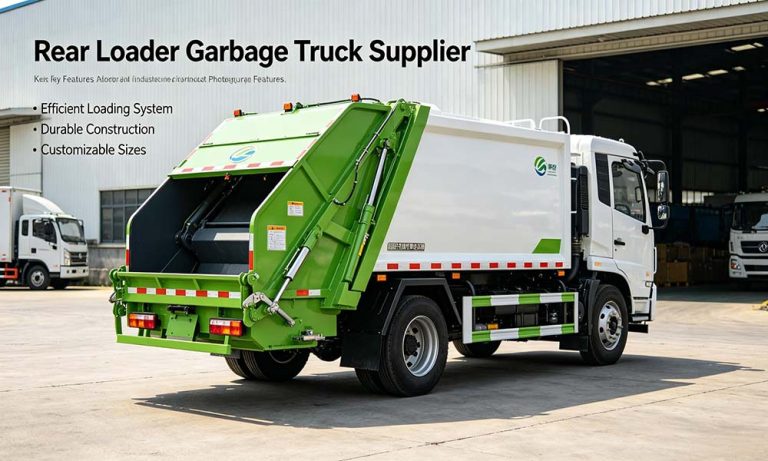
A rear loader normally collects waste into a permanently mounted garbage body through a rear loading opening.
A skip loader handles a detachable container.
| Fonctionnalité | Skip Loader | Chariot à chargement arrière |
|---|---|---|
| Main waste unit | Conteneur amovible | Fixed garbage body |
| Méthode de chargement | Hydraulic container lifting | Chargement par l'arrière |
| Échange de conteneurs | Oui | Usually no |
| Residential bins | Possible but not typical | Courant |
| Déchets professionnels | Adapté | Adapté |
| Déchets de chantier | Courant | Less typical |
| Industrial containers | Adapté | Cela dépend de la configuration |
| Compactage | Depends on system | Courant |
If a project involves individual household bins collected along a fixed route, a rear loader may be more suitable.
If the customer wants to collect and transport large detachable containers, a skip loader may fit the operating model better.
For standard rear-loading applications, see camion à ordures à chargement arrière à vendre.
13. Skip Loader Garbage Truck Price Factors
There is no single standard price for a skip loader garbage truck.
The final cost depends on the complete configuration.
Châssis
The chassis brand, engine, payload and axle configuration affect the basic vehicle price.
Système hydraulique
A higher-capacity hydraulic system may require larger cylinders, stronger arms and more powerful components.
Skip Loader Structure
The lifting arms, support frame and container locking system affect the vehicle cost.
Conteneur
If the customer requires new skip containers, their size, material and construction also contribute to the total project cost.
Automation
Additional controls or automated operating functions can increase the equipment cost.
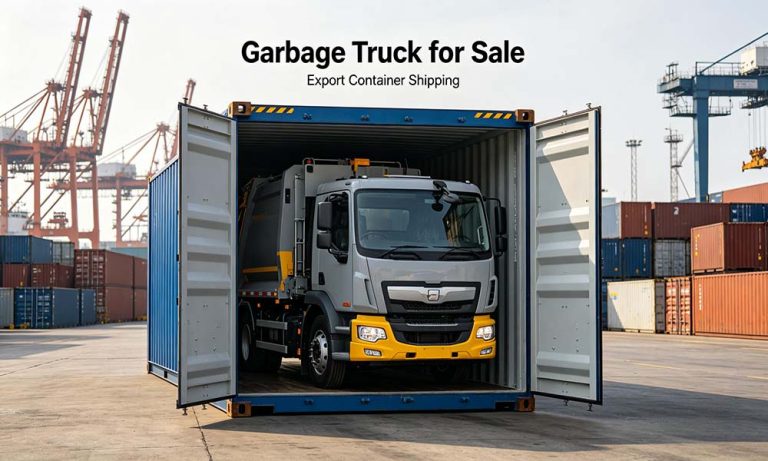
Configuration d'exportation
International buyers may need:
- Conduite à gauche ou à droite
- Destination-specific configuration
- Pièces de rechange
- Documentation
- Peinture
- Expédition
- Port de destination
For a more general explanation, see our prix d'un camion-poubelle guide.
14. How to Choose a Skip Loader Garbage Truck
Before selecting the truck, define the actual operating requirements.
1. What type of container will be used?
Confirm whether it is an existing container or a new container.
2. What is the container volume?
This determines the approximate waste volume per collection cycle.
3. What is the maximum loaded weight?
This is essential for selecting the hydraulic system and chassis.
4. What are the container dimensions?
The lifting arms need to match the container geometry.
5. What type of waste will be collected?
Construction waste and lightweight commercial waste can require different specifications.
6. How often will the container be collected?
High-frequency operations may require a durable hydraulic system designed for repeated cycles.
7. How far will the truck travel?
Longer routes may require additional consideration of payload and chassis configuration.
8. What road conditions will the truck encounter?
Road conditions influence chassis and suspension selection.
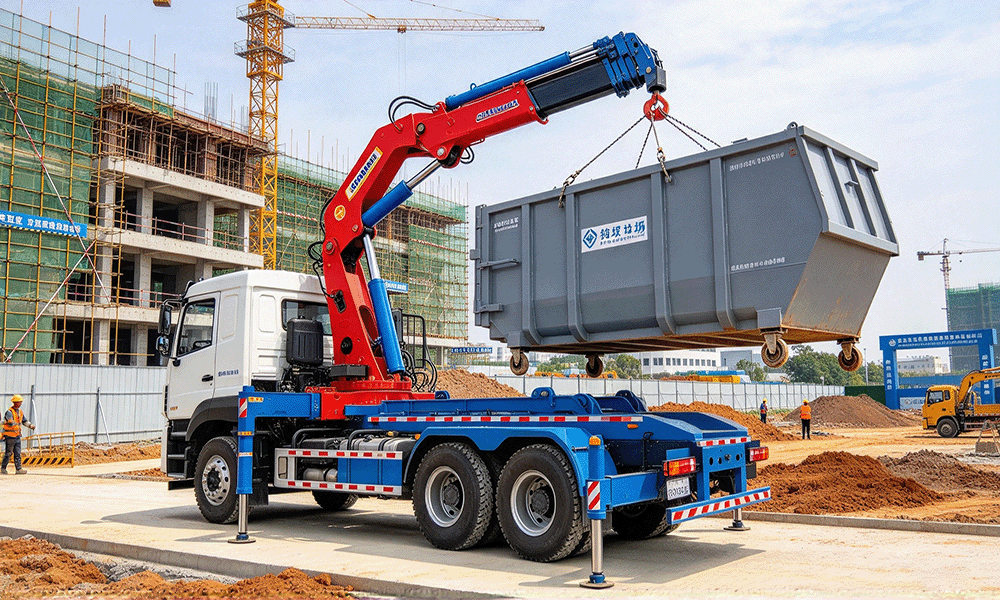
15. Skip Loader for Construction Waste
Construction waste is a common application for skip loader trucks.
The container can remain at the construction site until it reaches the required fill level.
The skip loader then arrives, loads the container and transports it away.
This approach can be useful when waste is:
- Bulky
- Irregular
- Heavy
- Generated continuously
- Difficult to collect with ordinary garbage bins
However, construction materials can create high loads.
The customer should therefore provide the expected maximum loaded weight rather than selecting the vehicle based only on container volume.
16. Skip Loader for Industrial Waste
Industrial waste collection often requires more careful payload planning.
Par exemple :
A factory producing packaging materials may generate a high volume of relatively light waste.
A metal-processing factory may generate a lower volume but much heavier waste.
These two customers may need completely different truck configurations even if they use containers with similar dimensions.
Before ordering, identify:
- Waste material
- Densité des déchets
- Container capacity
- Poids maximal en charge
- Fréquence de la collecte
- Average transportation distance
This information helps the manufacturer select the appropriate chassis and hydraulic system.
17. Skip Loader for Commercial Waste
Commercial properties can benefit from detachable waste containers when waste volumes are too large for ordinary bins.
Potential applications include:
- Centres commerciaux
- Hôtels
- Entrepôts
- Large restaurants
- Marchés
- Centres de distribution
- Commercial complexes
A skip container can remain at the site and be collected when full.
For businesses with multiple collection locations, the operating model can involve several containers and one or more skip loader trucks.
18. Can One Skip Loader Use Multiple Containers?
Yes, if the containers are compatible with the lifting system.
This can improve operational flexibility.
Par exemple :
Container A: At a factory
Container B: At a warehouse
Container C: At a construction site
When one container becomes full, the truck can collect it and transport it to the appropriate facility.
However, all containers should meet the required:
- Dimensions
- Lifting-point specifications
- Maximum weight
- Structural requirements
- Loading geometry
The truck should never be assumed to work with different container types without confirming compatibility.
19. What Should Be Included in a Skip Loader Truck Quotation?
A buyer should request a detailed quotation rather than only asking:
“How much is a skip loader garbage truck?”
A useful RFQ should include:
Truck
- Marque du châssis
- Chassis model
- Moteur
- Charge utile
- Configuration des essieux
- Position de conduite
Skip Loader
- Maximum lifting capacity
- Système hydraulique
- Cylinder specification
- Arm configuration
- Système de verrouillage de conteneur
Conteneur
- Volume
- Dimensions
- Matériau
- Poids à vide
- Poids maximal en charge
- Quantité
Commercial Terms
- Unit price
- FOB or CIF
- Port de destination
- Délai de livraison
- Warranty
- Pièces de rechange
This allows different suppliers to be compared more accurately.
20. Customized Skip Loader Garbage Trucks from TOPS VEHICLES
For export projects, the skip loader system should be matched to the customer’s actual container and waste collection conditions.
Au VÉHICULES TOPS, buyers can provide:
- Photos de conteneurs
- Dimensions du conteneur
- Container drawings
- Poids maximal en charge
- Type de déchet
- Capacité requise du camion
- Pays de destination
- Quantité
- Préférence en matière de châssis
The vehicle configuration can then be evaluated according to the project requirements.
For customers who already have skip containers, providing the existing container specifications before production is particularly important.
21. Skip Loader Garbage Truck Buying Checklist
Avant de passer commande, veuillez vérifier les points suivants :
- Type de conteneur confirmé
- Container volume confirmed
- Dimensions du conteneur confirmées
- Container empty weight confirmed
- Maximum loaded weight confirmed
- Lifting capacity confirmed
- Système hydraulique validé
- Lifting arm configuration confirmed
- Container connection confirmed
- Système de verrouillage des conteneurs validé
- Charge utile du châssis confirmée
- Axle configuration confirmed
- Waste type confirmed
- Road conditions confirmed
- Collection frequency confirmed
- Truck quantity confirmed
- Quantité de conteneurs confirmée
- Port de destination confirmé
- Pièces de rechange confirmées
- Délai de livraison confirmé
- Devis définitif confirmé
FAQ: Camion à ordures with Skip Loader for Sale
1. What is a skip loader garbage truck?
A skip loader garbage truck is equipped with hydraulic lifting equipment designed to pick up detachable waste containers and place them onto the truck for transportation.
2. What type of waste can a skip loader collect?
Skip loaders can be used for construction waste, industrial waste, commercial waste, bulky waste and certain recyclable materials.
3. Can a skip loader use different containers?
Yes, as long as the containers are compatible with the truck’s lifting system, dimensions, connection points and weight requirements.
4. What is the difference between a skip loader and a roll-off truck?
A skip loader generally uses hydraulic lifting arms to lift the container, while a roll-off system commonly uses a different loading geometry involving rolling or pulling the container onto the truck.
5. How much can a skip loader lift?
The lifting capacity depends on the hydraulic system, arm configuration, container dimensions, lifting geometry and chassis. The maximum loaded container weight should be provided when requesting a quotation.
6. Can a skip loader handle construction waste?
Yes. Skip loaders are suitable for many construction waste applications, provided the container and truck are designed for the required load.
7. Can skip loaders be used for industrial waste?
Yes. They can be configured for industrial containers, but heavy industrial waste may require a stronger chassis and higher lifting capacity.
8. How much does a skip loader garbage truck cost?
The price depends on the chassis, lifting capacity, hydraulic system, container specifications, quantity and export configuration.
9. What information should I send to get a quotation?
Provide container dimensions, volume, empty weight, maximum loaded weight, waste type, required truck capacity, quantity and destination port.